Your challan book,
but it remembers.
Every slip you write, every copy you are waiting on, every payment that has not started — in one register you can open from the workshop floor. No more flipping pages to find out who owes you what.
- Email or Google sign-in
- Invite your partner
- Works on any phone
The book works, right up until it doesn’t
Nothing is wrong with the chopadi. It is a good record. It just cannot count, cannot remind you, and cannot be in two places at once.
The promised date lives in your head
A vepari asks for Thursday. By Thursday there are nine other slips on the table. The one that slips is the one you hear about.
Copies go out and never come back
Payment starts when the copy that gates it returns. If nobody is counting, it sits in a drawer and so does your money.
Nobody can total the book
How many pieces are out right now, across how many veparis? The answer is in the book — one page at a time.
One book, one pair of hands
Your partner cannot check a challan from the shop while the book is with you at the market.
A whole book, on whatever you have to hand
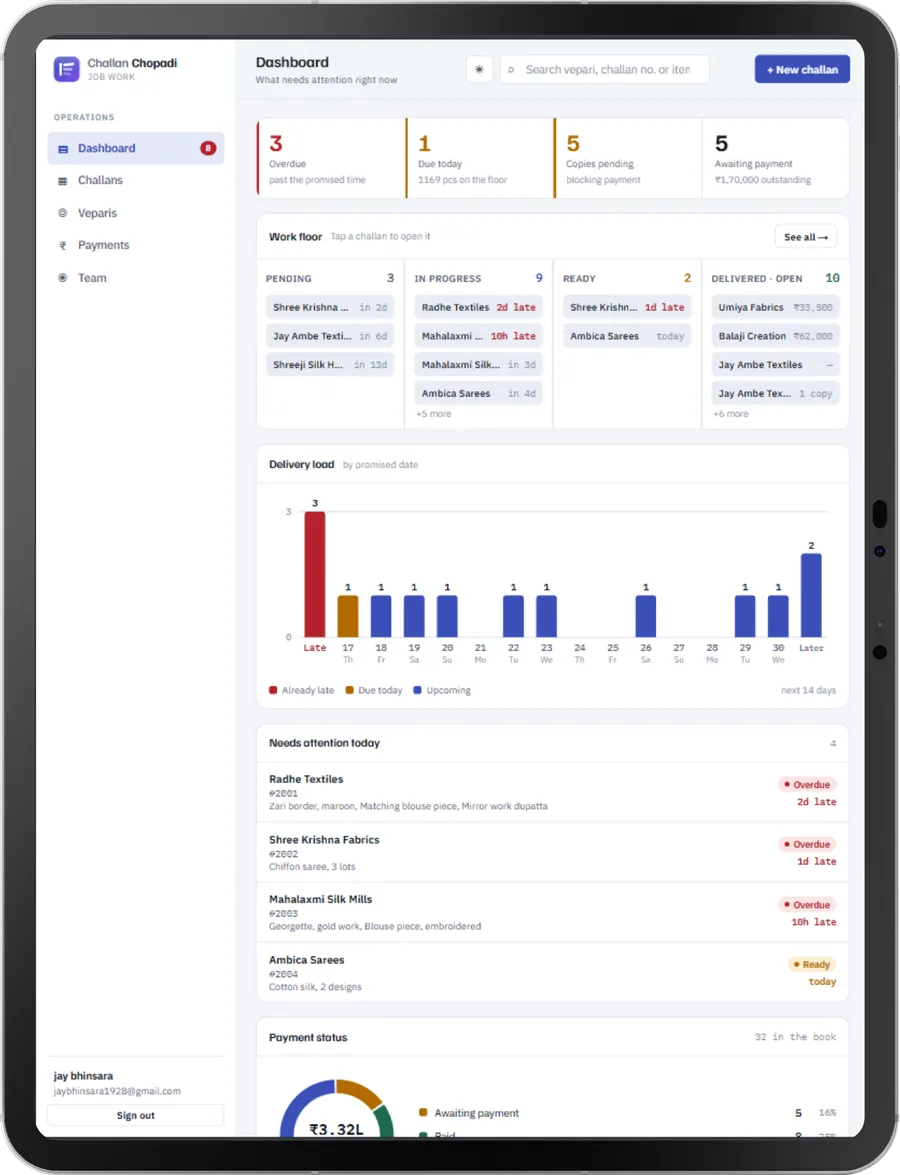
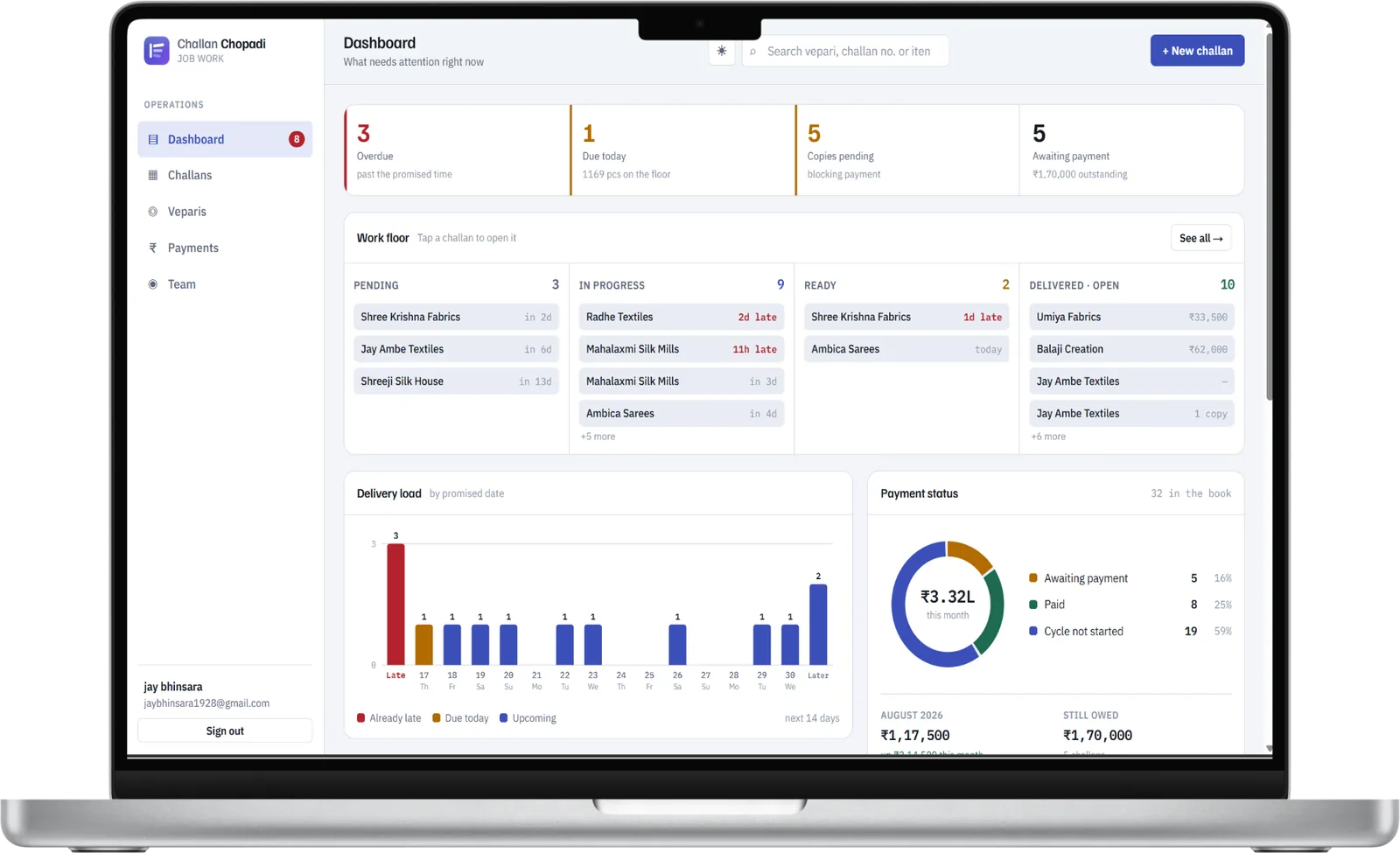
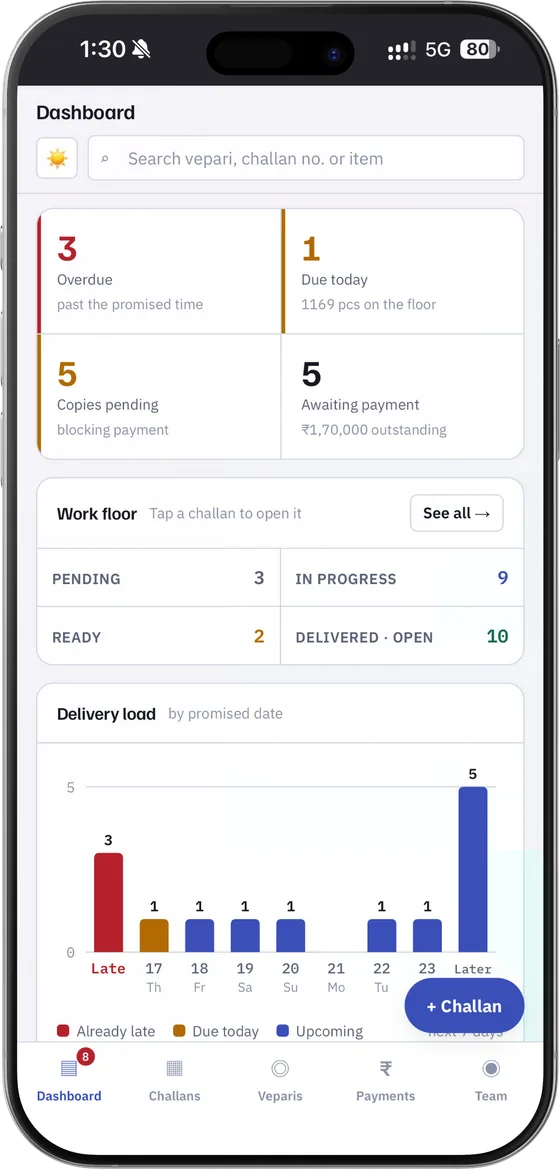
The same register on the desk, on the counter and in your pocket — full tables where there is room, tap-sized cards where there is not. Nothing to install.
Four steps, and they match how you already work
This is not a new system to learn. It is the same slip, the same copies, the same payment cycle — written down somewhere that can add up.
- 01
Write the slip once
Vepari, challan number, what came in, what you promised. Items go in the way the slip is written — sarees counted, blouse pieces measured, anything else in your own words.
- 02
Let the dates chase you
Due today, due this week, already late. The dashboard puts the overdue work first, because that is the call you are about to get.
- 03
Tick the copies as they return
White, pink, yellow — the same sheets that sit in your book. The copy that starts the payment cycle is marked, so you know the moment the clock begins.
- 04
Settle, and lock it
Record the payment, how it arrived, and the challan turns read-only with its full history intact. Nothing quietly changes after the money is in.
Built around the challan, not around a spreadsheet
Carbon copies, tracked
Set up your copy book once — as many sheets as you use, with the payment trigger marked. Every challan then tracks them individually.
Dates that cannot go backwards
A promised date before the date you received the goods is a typo, not a plan. It is refused at entry.
Payment aging at a glance
What is owed, by whom, and how long it has been sitting there — grouped by how old it is, so the oldest never goes quiet.
Your partner, same chopadi
Invite a co-worker and you both see the same register in real time. Only the person who created the workspace can invite or remove.
Made for the phone in the workshop
Full tables on a desktop, tap-sized cards on a phone. Same register, no pinching and scrolling sideways.
Light or dark, your call
A bright shop floor and a late night at the desk want different screens. One tap switches, and it remembers.
The things people ask before they start
Anything not answered here — ring +91 75679 36593 or write to jaybhinsara9@gmail.com. A real person reads it.
What is a job-work challan?
It is the slip that travels with goods when they leave one place for work rather than for sale — fabric going out for embroidery, printing or stitching, and coming back finished. The slip records what went, when it was promised back, and who has it. Challan Chopadi keeps that same record, one entry per slip.
Do I have to change the way I write my challan book?
No. You set up your copy book once — as many carbon sheets as you actually use, in your own names, with the one that starts the payment cycle marked. After that you enter each challan the way you already write it, and the app tracks the copies individually.
Is this GST invoicing or billing software?
Not today. What it does now is the half your billing software ignores: what is out, what is late, which copies have not come back, and which payments have not started. It does not raise a GST invoice, generate an e-way bill or file a return, so keep doing those wherever you do them now. That is a starting point, not the finish line. Challan Chopadi is in active development and is being built out in phases, working towards one place that handles the whole job-work cycle instead of the half of it every other tool leaves alone. What arrives next is decided by what workshops actually ask for — so if something is missing for you, tell us and it goes on the list.
Can my partner or worker use the same register?
Yes. The person who creates the account can invite co-workers by email, and everyone then sees the same challans in real time from their own phone. Only that first owner can invite or remove someone.
Does it work on a phone?
It is built for one. The register becomes tap-sized cards on a phone and full sortable tables on a desktop, and it is a website — nothing to install from an app store.
What happens to a challan after it is paid?
It locks. The challan becomes read-only with its whole history intact, so nothing can be quietly edited after the money is settled. If something genuinely needs correcting, you undo the payment first, fix it, and record the payment again.
Start with the slips that are still open
Log the challans you are currently waiting on and you are caught up. Everything after that is one slip at a time.